
Blog archive December 2025
<< November 2025 / January 2026 >>
06.12.25 / 01 / family tree 2
I was surprised when various friends said they had no interest in their family trees. I know some people are obsessive about it, but if I were a Maori, an African, a Jew or a member of the Sicilian Mafia nobody would be surprised that I was researching my kinship network.
Modern Western society encourages us to see ourselves as individuals, without significant ties to kin or tradition or place. This brings many benefits in terms of self-actualisation, as well as oiling the wheels of capitalism and consumerism. The cost is alienation. Our psychology developed in tribes - the business of Dunbar’s number/the monkeysphere is about tracking relationships in a kinship group. Having broken free from family we recreate it as ‘chosen family’. Who and how we are in the world is always relational.
[Maybe Dunbar's number is why I baulk at researching the other ten siblings on every 19th century family tree branch. There's a point at which you want to limit the number of people in your 'relational family' to ones you can care about!]
So in researching my family tree I am renarrating myself. There is no scientific mechanism that I know of to make me want to do what my forebears have done - though I can imagine a cultural imperative. But this is to say that we construct a personal narrative that includes our family. Nowadays that is taken to mean only our immediate family, but to research one’s wider and deeper family opens one up to the possibility of them affecting one’s narrative too. It’s hard to learn that one comes from a long line of fishermen and sailors without wondering whether one should also have been one. We are encouraged to see it as a purely personal decision, but it feels strange that a chain has been broken (of course there are chains that need to be broken, but we are looking at honourable occupations). My nieces are good sailors, they just need to start catching fish :)
05.12.25 / 01 / family tree
Meanwhile I have been researching my family tree on Ancestry since late 2024. This had been coming for a long while, for a number of reasons. My brother had received a box of old family certificates going back into the 19th century, on our father’s side. My mother had told me all kinds of things over the years that I had surreptitiously written down and tried to make sense of in a self-created tree. She came from a broken home, she lost contact with her father and his family, and then with her mother’s family as well, so there was a mystery. We had a few photos, a couple of names, a few stories. My brother set up on Ancestry and joined me in. When my mother died and I came into possession of the family photos and other old documents, it gave new impetus.
It’s an extraordinary rabbit hole. It involves databases and archives connecting out there and feeding you stuff. You sift evidence in the light of stories or knowledge that you have. It feels like detective work in a story. Startling revelations arrive at 2:30am when you are about to go to bed. If you find the right thread to pull, a person’s life history can come tumbling out of nowhere in detail - otherwise there’s nothing. Military records tell you a lot - in illegible Edwardian handwriting. Old family hearsay is proved true, but there are hidden surprises and scandals.
On my father’s side I come from a long line of sailors and fishermen. We followed the fishing trade from Barking in the 19th century, to Great Yarmouth, to Grimsby. My mother’s side were itinerant farm labourers in the fens of Lincolnshire - constantly moving from farm to farm in the same 10-mile radius in what must have been a hard existence.
Back in the 19th century everyone had 6 or 10 siblings, which is daunting - too much new family! But some are very interesting. One sets up boundaries - do we have photos, or stories, or artefacts? Some people are ‘the family’, others are visitors who married in - it’s a subjective thing, where the main stream is. It depends on where you are in the tree.
The people I would most like to meet are two of my great-grandfathers, one on each side. Both feel like key characters in our family. Both led interesting but very different lives. My father’s grandfather was a sailor. His ship was in Hamburg when WW1 broke out, and he spent the war in a famous POW camp - we have the postcards. After the war he retired from the sea and operated the dock gates in Grimsby. My mother’s grandfather was in the Royal Field Artillery in the Boer War, then joined up again in 1914. He fought in Belgium in 1915, then in the Balkans in 1916 before being invalided out in early 1918. He separated from his wife and children early in the war, and by the time my mother knew him in the 1940s he was living with a woman who was not his wife - but he was a Roman Catholic and perhaps couldn’t get a divorce.
Another surprise was one of my father’s great-uncles. He was a fisherman, but also a Naval Reserve. In 1915 his boat vanished without trace. No-one knows what happened, but the crew are listed on the big war memorial next to the Tower of London which commemorates those who died at sea in both wars and who have no grave. Fishing is always risky and was riskier in the war, but fishing boats were also used for covert spying on German shipping movements, which may explain the memorial and the medals to his widow. We have his Bible.
03.12.25 / 01 / filofax
See, this is how a rabbit hole happens.
I wanted to fix the velcro on my umbrella (the bit that wraps round and holds it closed). I got the sewing box out and found that the cotton had mould on - an old leather cord had gone mouldy. So I got the rest of the things out of the drawer to check them, including all the Filofax diary inserts that I had kept right back to the 80s. I had been thinking about getting rid of them anyway, but of course I had to go through them to check. Keeping them wasn’t just sentimentality - it was essential pre-digital record keeping. Periodically one would need to give precise dates of employment or residence for something.
It wasn’t just an 80s fad, although a matt black Filofax in a Chevignon backpack made me ‘one of the 11 trendy people this week’ (The Face) in 1988. It was the analogue equivalent of a smartphone, with paper apps.
I got a Filofax in late 1987 after a change of job, to record my work diary, timesheet hours, contacts etc in a compact and professional way. One was given ‘work diaries’ but they were always ugly and random formats. One thing you could do with a Filofax was keep half of the previous year’s diary in alongside the coming year, so you could refer back. There were lots of tempting multicoloured inserts for all kinds of things, I bought a few but didn’t much need them - it was always about the diary.
I always recorded the truth about my work hours and what I was doing in my own diary - and then chose what to record officially. Some employers didn’t allow you to record overtime, but I always kept a record of actual hours. I think it’s disgraceful and stupid not to know what your workforce are actually doing, regardless of whether you pay them for it or not. You need to know who’s under pressure, or struggling, or slacking, which projects need resources and so on. Until the late 2010s, working hours recorded on weekends meant I had travelled into the office. It’s sad to see how often that happened.
Eventually digital record-keeping and calendars took over, but it took a while for them to be reliable and to sync properly between devices and software formats (and one’s work calendar isn’t portable between employers). Until then the Filofax was a stable personal record. I started to use Apple Calendar at the beginning of 2013 - it is empty before - and I stopped using the Filofax.
The problem by then was that the information didn’t sync. This wasn’t an issue when nothing synced, but it became an issue when other things did. Digital things shift about because there’s little cost to doing so. It became tiresome to cross out and rewrite meetings that kept changing time and venue right up to the last minute. And phone numbers in a Filofax can’t be called by touching them.
My first binder was a 1987 ‘Wellington’ in ribbed black rubber. I have haptic memories of the magnetic clasp and rubber ribs when I look at pictures. The chunky thingness of it was pleasing, I wish I'd kept it. In 1999 I got the Personal Active model, also rubberized, which zipped up to stop the inserts getting dirty in my bag - but it was a big beast. I downsized in about 2010 to a small one to save space and weight.
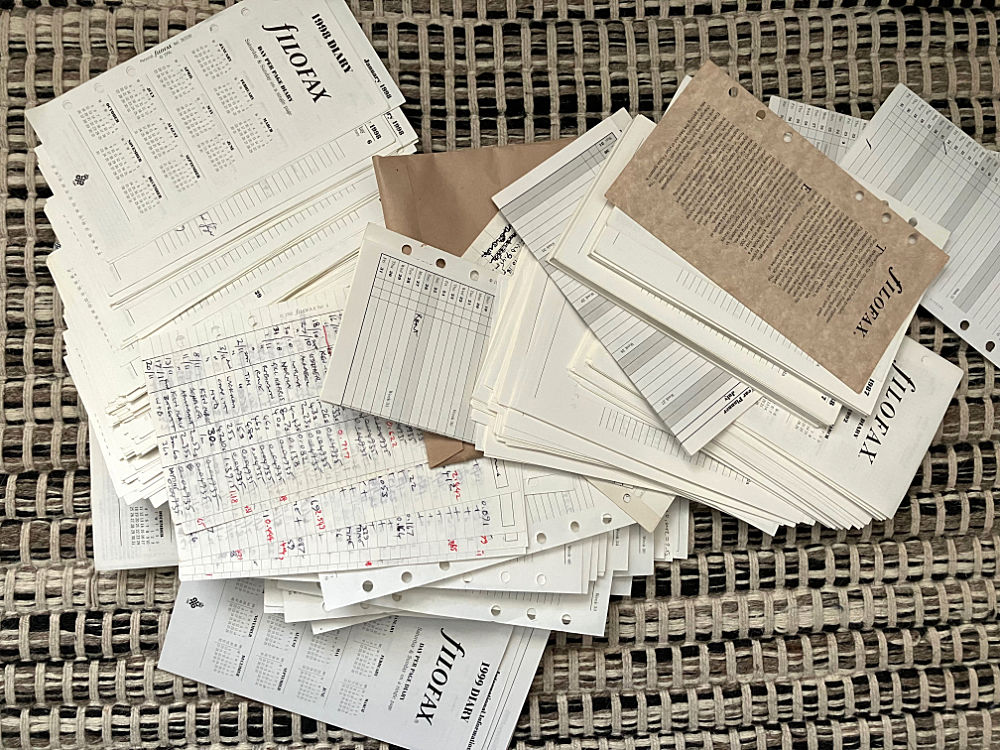
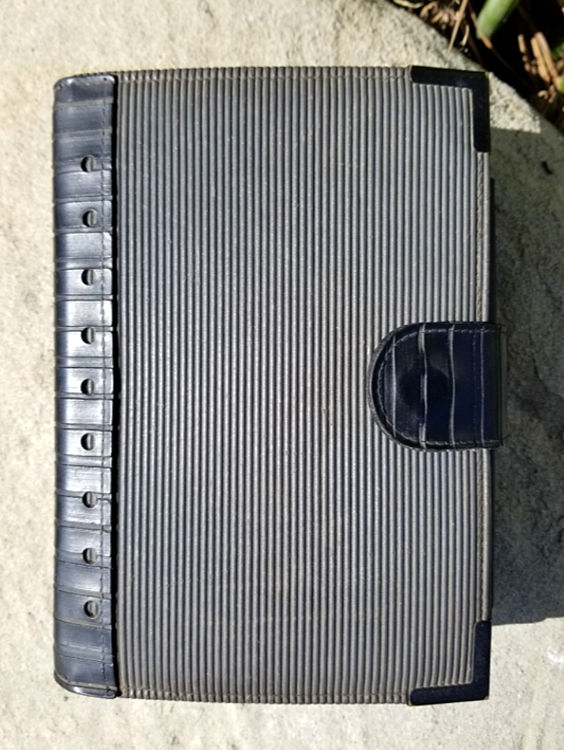
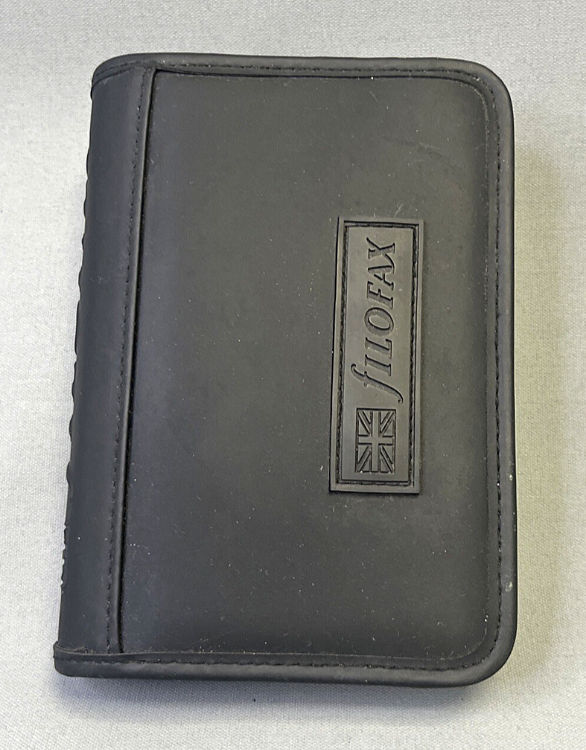
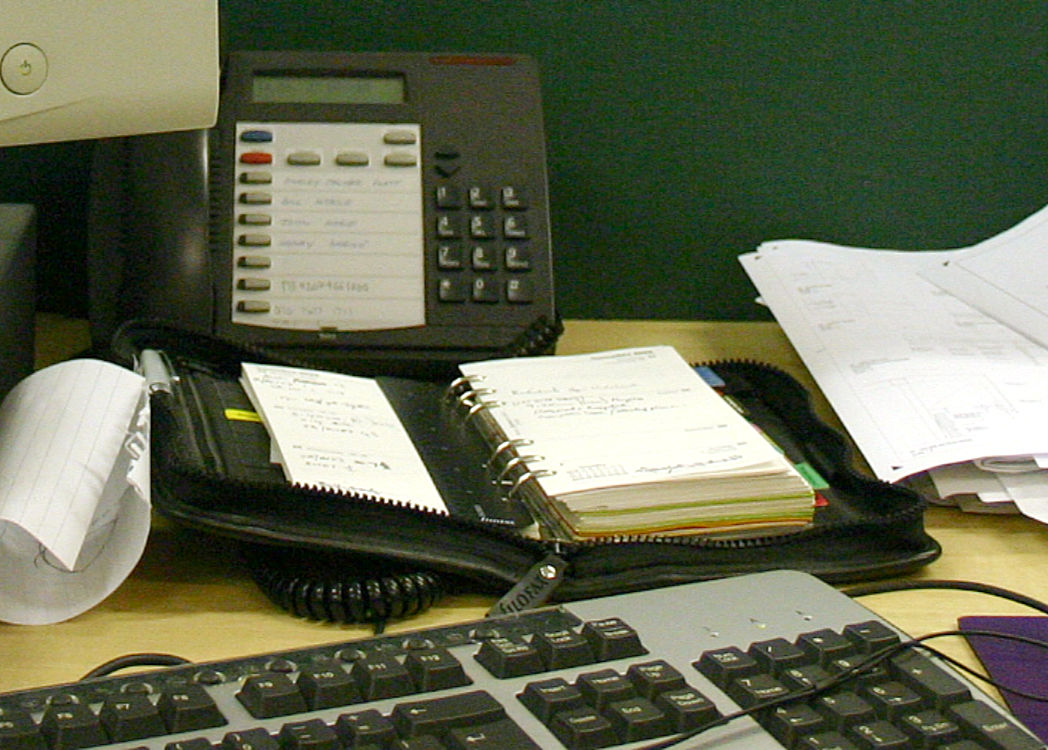
Above, some of my old inserts, 1987 Wellington, 1999 Personal Active (not my photos), my untidy desk 2003.
The place of the Filofax in my bag was taken by a moleskine for notes and sketches. It’s more compact and stays bound in its cover when you’ve finished with it. It’s strange that I never used the Filofax for that kind of thing, I always meant to.